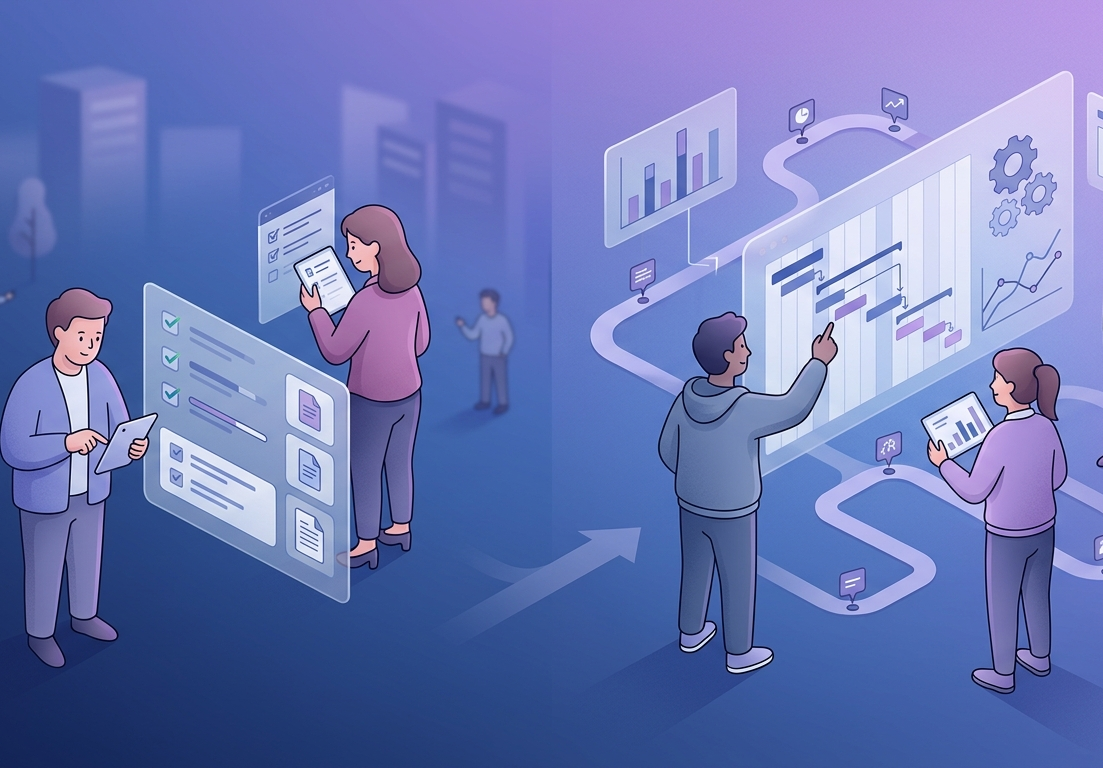
As projects become more complex, organizations often invest in project management software expecting it to solve every productivity challenge. Yet despite adopting new tools, many teams continue to struggle with missed deadlines, unclear priorities, and inefficient workflows. One of the reasons is surprisingly simple: many people use the terms task management and project management interchangeably, even though they represent two very different concepts.
Understanding this distinction is more than a matter of terminology. It influences how teams plan work, communicate with one another, assign responsibilities, and measure progress. While both disciplines aim to improve execution, they operate at different levels and answer different questions. Recognizing when to focus on tasks and when to think in terms of projects helps organizations build better processes and choose tools that truly support the way they work.
What Is Task Management?
Task management focuses on individual units of work. A task is a specific action that needs to be completed, usually by a particular person and often within a defined timeframe. Examples include writing documentation, reviewing a pull request, designing a homepage, or responding to customer feedback.
Managing tasks involves organizing these activities, assigning ownership, setting deadlines, and tracking completion. At its core, task management helps individuals understand what they need to do next and ensures that work does not get forgotten.
For individuals and small teams, effective task management often provides immediate improvements in productivity. Instead of relying on memory or scattered notes, work becomes visible, prioritized, and easier to organize.
However, tasks rarely exist in isolation. Most contribute to a larger objective, and that is where project management begins.
What Is Project Management?
Project management takes a broader perspective. Rather than focusing on individual tasks, it focuses on delivering an entire outcome.
A project is a temporary initiative designed to achieve a specific goal, such as launching a website, developing a mobile application, implementing new software, or organizing a marketing campaign. Every project consists of many interconnected tasks, but it also includes planning, scheduling, budgeting, resource allocation, risk management, communication, and stakeholder coordination.
While task management asks, "What needs to be done today?", project management asks, "How do we successfully deliver the entire project?"
This broader perspective requires teams to think about priorities, dependencies, timelines, milestones, and the relationship between different pieces of work rather than viewing tasks independently.
The Relationship Between Tasks and Projects
Task management and project management are not competing approaches. Instead, they complement one another.
Every successful project is built from hundreds, or sometimes thousands, of individual tasks. Completing those tasks is essential, but completing tasks alone does not guarantee project success.
Imagine a construction project where every contractor finishes their assigned work on time, but the plumbing team arrives before the building's foundation is complete. Although each task may have been executed successfully, poor coordination causes the overall project to fail.
This illustrates one of the fundamental principles of project management: success depends not only on completing work, but on completing the right work at the right time.
Project management provides the structure that allows individual tasks to contribute toward a common objective.
Key Differences Between Task Management and Project Management
Although they work together, task management and project management differ in several important ways.
Task Management
- Focuses on individual activities
- Organizes daily work
- Tracks assignments and deadlines
- Often individual or team-level
- Measures task completion
Project Management
- Focuses on delivering an overall objective
- Organizes the entire project lifecycle
- Manages timelines, risks, resources, and milestones
- Typically involves multiple teams and stakeholders
- Measures project success
Understanding these differences helps organizations avoid a common mistake: believing that checking off tasks automatically means a project is progressing successfully.
Why Teams Often Confuse the Two
The confusion usually begins with software.
Many modern platforms support both task management and project management, making it easy to assume they are essentially the same. In reality, the software simply provides different views of the same work.
A Kanban board may display individual tasks, while a roadmap shows milestones, dependencies, and long-term planning. Both views are valuable because they answer different questions for different audiences.
Psychologically, people also tend to focus on immediate work because it provides frequent feelings of accomplishment. Completing tasks triggers a sense of progress, making it tempting to prioritize activity over outcomes.
However, productivity is not measured by how many tasks are completed. It is measured by whether those tasks move the project closer to its intended goal.
When Is Task Management Enough?
Not every piece of work requires full project management.
Individuals managing personal responsibilities, freelancers handling independent client work, or small teams working on straightforward assignments may only need task management. If work has few dependencies, limited complexity, and clear ownership, organizing tasks may be sufficient to stay productive.
In these situations, introducing detailed project management processes can create unnecessary overhead without improving outcomes.
The key is matching the level of management to the complexity of the work.
When Does Project Management Become Necessary?
As work becomes larger and more collaborative, project management becomes increasingly important.
Multiple stakeholders, shared deadlines, cross-functional teams, limited resources, and competing priorities introduce complexity that individual task lists cannot effectively manage. Teams need visibility into how work connects, which tasks depend on others, where risks exist, and whether the project remains on track.
This is why growing organizations gradually shift from simply managing tasks to actively managing projects.
The goal is no longer just completing work, it is coordinating work.
How Modern Project Management Platforms Bridge Both
Modern project management platforms combine task management and project management into a single system.
Individual contributors can focus on their assigned work through task lists or Kanban boards, while managers monitor overall progress using dashboards, timelines, workload reports, and project roadmaps. Instead of maintaining separate tools for daily work and strategic planning, teams gain visibility across every level of execution.
This unified approach reduces communication gaps, improves accountability, and allows organizations to scale without losing clarity.
Rather than forcing teams to choose between task management and project management, modern platforms recognize that successful execution requires both.
Final Thoughts
Task management and project management serve different purposes, but neither replaces the other.
Task management ensures that individual pieces of work are completed efficiently. Project management ensures those pieces come together to achieve a larger objective. Organizations that understand this relationship build stronger workflows, improve collaboration, and make better decisions because they can see both the details and the bigger picture.
The most effective teams do not simply complete tasks. They understand how every task contributes to meaningful progress.
Visibility Beyond Individual Tasks
Managing tasks is an important first step, but growing teams need more than organized to-do lists. They need a shared view of priorities, timelines, dependencies, and progress across every project.
That's where Polaris helps. By combining task management with powerful project management features, Polaris gives teams the visibility they need to stay aligned, collaborate effectively, and deliver work with confidence.
Discover how Polaris helps teams manage both tasks and projects in one place.