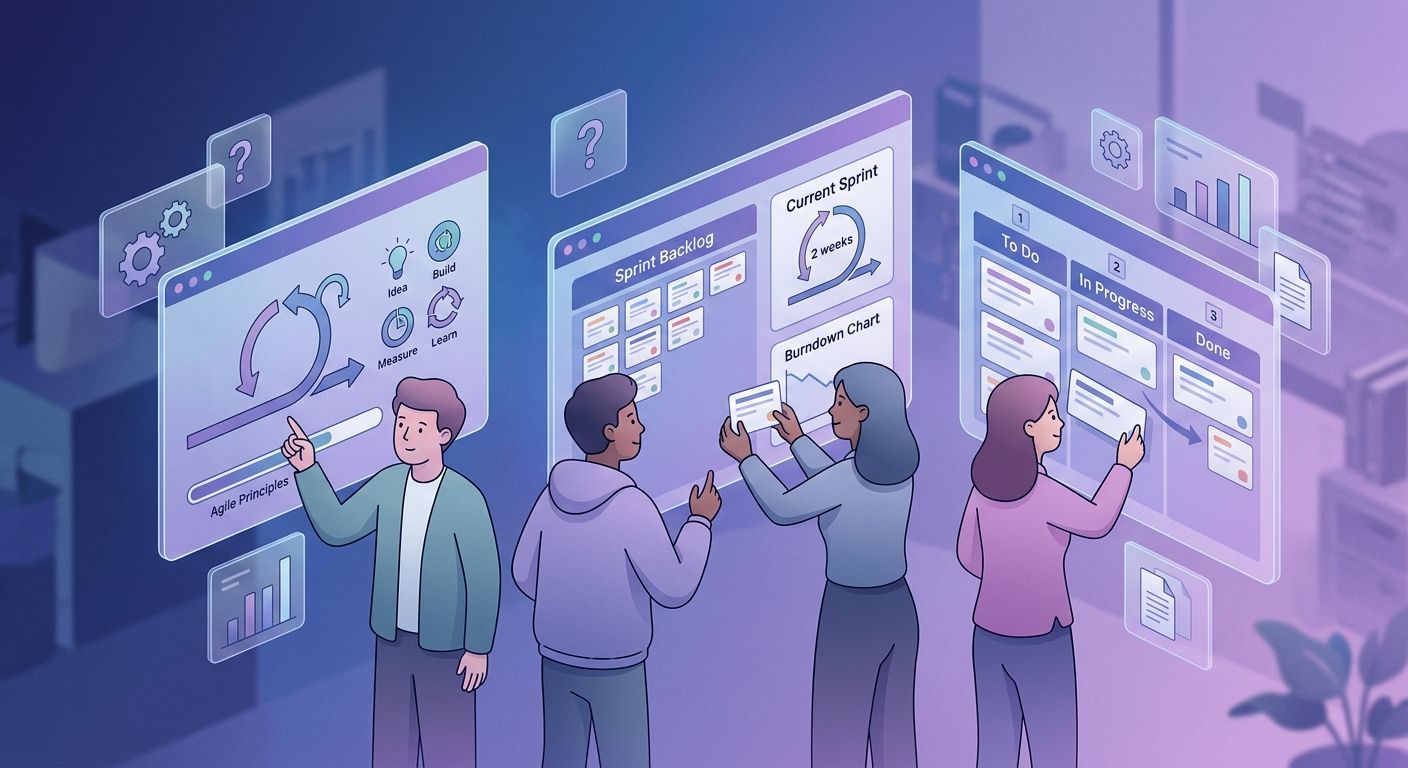
Agile, Scrum, and Kanban Explained: Choosing the Right Framework
Every growing team eventually faces the same challenge: how do we organize work efficiently as complexity increases?
At the beginning, managing projects feels simple. A small team communicates directly, everyone understands what needs to be done, and tasks move forward naturally. A conversation, a shared document, or a quick meeting is often enough to keep everything aligned.
But as teams grow, work becomes harder to coordinate.
More people become involved, projects become interconnected, deadlines become more important, and priorities change faster. Suddenly, everyone is working hard, but progress feels slower. Tasks get forgotten, priorities become unclear, and teams spend more time discussing work than actually completing it.
This is where project management frameworks become valuable.
Frameworks like Agile, Scrum, and Kanban provide teams with structures for organizing work, improving communication, and adapting to change. However, these terms are often used interchangeably, creating confusion.
A team might say they are "using Agile" when they actually mean Scrum. Another team might adopt Kanban because it is popular without understanding whether it fits their workflow.
The truth is that these approaches solve different problems.
Understanding the differences between Agile, Scrum, and Kanban allows teams to choose a system that matches their environment instead of forcing their work into a framework that does not fit.
Understanding Agile: A Mindset Before a Framework
Agile is often misunderstood as a specific project management method. In reality, Agile is a mindset built around flexibility, collaboration, and continuous improvement.
Traditional project approaches often follow a predictable sequence: planning everything upfront, executing the plan, and delivering the final result. This works well when requirements are stable and changes are unlikely.
However, many modern projects do not work this way.
Customer expectations change. Market conditions shift. New information appears during development. A plan created six months ago may no longer represent what the team actually needs.
Agile approaches accept that change is normal.
Instead of trying to predict every detail from the beginning, Agile encourages teams to work in smaller cycles, gather feedback, and continuously improve their approach.
The core ideas behind Agile include:
- Delivering value frequently instead of waiting until the end.
- Collaborating closely with customers and stakeholders.
- Adapting plans based on new information.
- Improving processes through regular reflection.
Agile is not about working faster by doing more tasks. It is about creating a system where teams can respond intelligently to change.
Scrum: Structure for Teams Working in Iterations
Scrum is one of the most popular ways organizations apply Agile principles.
While Agile provides the philosophy, Scrum provides a specific structure.
Scrum organizes work into fixed periods called sprints, usually lasting between one and four weeks. During each sprint, the team selects a group of tasks, focuses on completing them, reviews the results, and improves the process before starting the next cycle.
A Scrum team usually includes specific roles:
Product Owner
The Product Owner represents the customer perspective and helps prioritize what should be built. They manage the product backlog and ensure the team focuses on the highest-value work.
Scrum Master
The Scrum Master helps the team follow the Scrum process, removes obstacles, and improves collaboration.
Development Team
The team members responsible for designing, building, testing, and delivering the product.
Scrum also introduces several important ceremonies:
Sprint Planning:
The team decides what work will be completed during the upcoming sprint.
Daily Scrum:
A short meeting where team members discuss progress, challenges, and priorities.
Sprint Review:
The team demonstrates completed work and gathers feedback.
Sprint Retrospective:
The team reflects on what worked well and what can be improved.
Scrum works especially well for teams building products where priorities change but require focused periods of execution.
Kanban: Visualizing Work and Improving Flow
Unlike Scrum, Kanban does not organize work around fixed time periods.
Instead, Kanban focuses on visualizing work, limiting unfinished tasks, and improving workflow efficiency.
A typical Kanban board contains columns representing different stages of work:
- To Do
- In Progress
- Review
- Completed
Each task is represented as a card that moves across the board as work progresses.
The simplicity of Kanban is one of its biggest strengths.
Teams can immediately see what is being worked on, where bottlenecks exist, and what tasks are preventing progress.
One of Kanban's most important concepts is Work In Progress (WIP) limits.
Many teams struggle because they start too many tasks simultaneously. People constantly switch between projects, reducing focus and increasing completion time.
WIP limits encourage teams to finish existing work before starting new tasks.
Kanban is particularly effective for teams with continuous workflows, such as:
- Customer support teams
- Marketing teams
- Maintenance teams
- Operations teams
Instead of asking, "What should we start next?" Kanban encourages teams to ask, "How can we improve the flow of work?"
Agile vs Scrum vs Kanban: What Is the Difference?
The easiest way to understand the relationship is:
Agile is the mindset. Scrum and Kanban are methods for applying that mindset.
- Agile defines the principles behind flexible work.
- Scrum provides a structured framework with defined roles, meetings, and sprint cycles.
- Kanban provides a visual workflow system focused on efficiency and continuous delivery.
They are not competitors. Many organizations combine elements from each approach depending on their needs.
For example, a software development team might use Scrum sprints while also using Kanban boards to visualize progress.
A marketing team might follow Agile principles while using Kanban to manage campaigns.
The goal is not choosing the most popular framework. The goal is choosing the system that helps your team work better.
Choosing the Right Framework for Your Team
The right framework depends on the type of work your team does, how predictable your projects are, and how frequently priorities change.
Choose Scrum When:
Scrum works well when:
- Your team builds products or projects with clear goals.
- Work can be divided into focused development cycles.
- Regular feedback is important.
- The team benefits from defined roles and responsibilities.
For example, a software team developing a new application may use Scrum to organize development into manageable releases.
Choose Kanban When:
Kanban works well when:
- Work arrives continuously.
- Priorities change frequently.
- The team handles many different requests.
- Speed and workflow visibility are important.
For example, a customer support team receiving hundreds of requests daily may benefit more from Kanban than Scrum.
Choose Agile When:
Agile principles are valuable when:
- The environment changes frequently.
- Customer feedback influences decisions.
- Teams need flexibility.
- Innovation is a priority.
Agile can be applied in almost any industry because it focuses on how teams think rather than following strict rules.
Common Mistakes When Implementing These Frameworks
Many organizations adopt frameworks because they hear successful companies use them. However, copying a process without understanding its purpose often creates unnecessary complexity.
One common mistake is treating Scrum meetings as a checklist instead of using them to improve collaboration.
Another mistake is creating a Kanban board but ignoring workflow problems. A board alone does not improve productivity if teams continue multitasking without limits.
Some teams also believe Agile means having no planning. In reality, Agile involves continuous planning and adaptation, not the absence of structure.
A framework should support the team, not become a burden.
Frameworks Are Tools, Not Solutions
A project management framework cannot fix every organizational problem.
A team with unclear goals, poor communication, or ineffective leadership will struggle regardless of whether they use Scrum, Kanban, or another method.
Frameworks create better environments for good teamwork, but they do not replace the fundamentals.
The most successful teams use frameworks as tools for improving collaboration, increasing visibility, and creating better habits.
The framework matters, but the mindset behind it matters more.
Final Thoughts
As teams grow, informal communication stops being enough. Work becomes more complex, priorities shift faster, and organizations need systems that help people stay aligned.
Agile provides the foundation for adapting to change. Scrum gives teams structure through focused cycles. Kanban improves workflow by making work visible and reducing bottlenecks.
There is no universally perfect framework.
The best approach is the one that matches your team's reality, supports your goals, and helps people focus on delivering meaningful results.
Great teams are not defined by the tools they use. They are defined by how effectively they organize, communicate, and improve.
Turn Agile Principles Into Daily Execution With Polaris
Understanding Agile is only the first step. The real challenge is applying these principles consistently in everyday work.
Many teams adopt Agile ideas but struggle with execution. Meetings become disconnected from actual progress, priorities become unclear, and tasks get lost between conversations, documents, and different tools.
Polaris was built to solve this exact challenge.
By combining the flexibility of Kanban boards with the structured approach of Scrum workflows, Polaris gives teams the ability to organize work in a way that matches how they actually operate.
Teams can visualize their workflow, track progress, manage priorities, organize tasks into clear cycles, and collaborate around shared goals, all while following the core Agile philosophy of continuous improvement and adaptability.
Whether your team works in short sprints, manages continuous workflows, or combines both approaches, Polaris provides the foundation needed to turn ideas into organized execution.
Because Agile is not about following a specific framework. It is about creating a better way for teams to plan, collaborate, adapt, and deliver value.
Build your team's Agile workflow with Polaris and create a smarter system for getting work done.