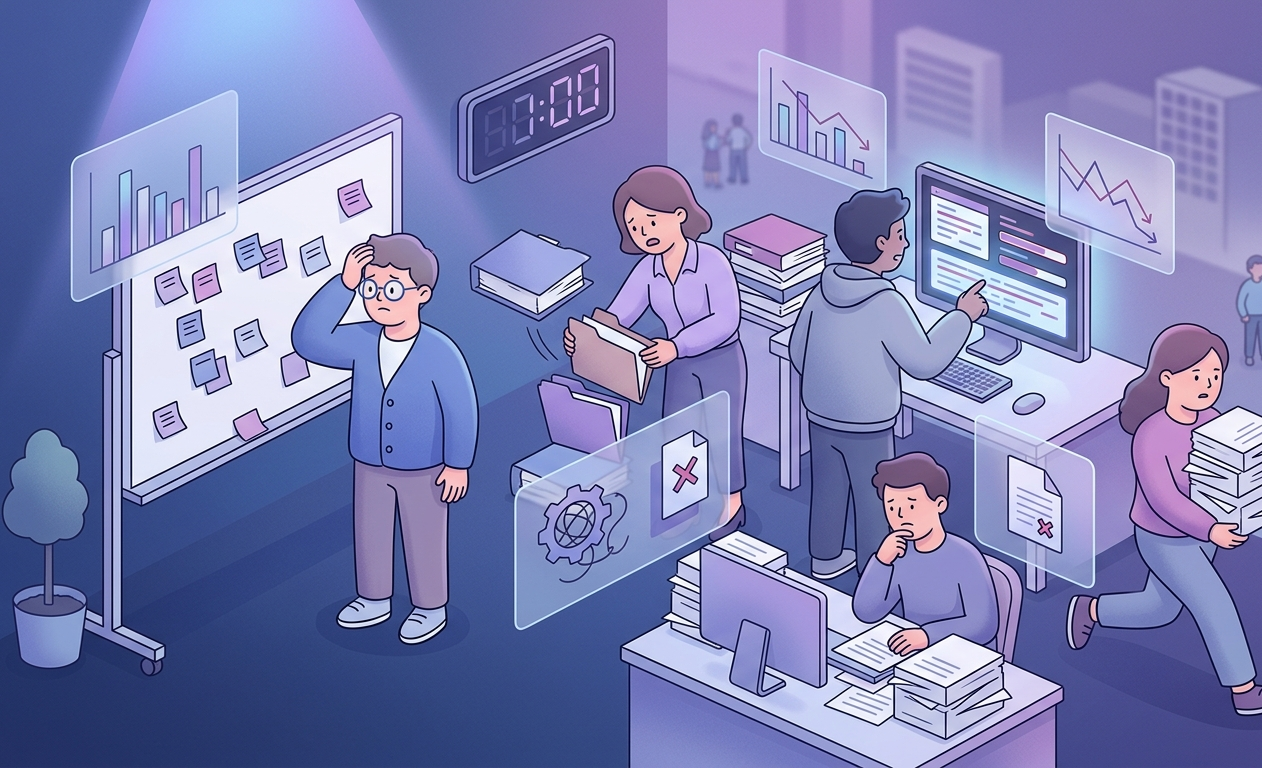
Growth Creates Complexity Before It Creates Stability
Every growing business eventually reaches a point where the methods that helped it succeed begin to create new challenges. In the early stages, companies benefit from speed and flexibility. Teams are small, communication is direct, and everyone understands how work gets done because they are close to every decision. A process does not need to be written down because the people responsible for it are always available.
However, growth changes the way information moves through an organization.
As more employees join and responsibilities become more specialized, the informal systems that once worked perfectly start becoming unreliable. A new employee may not know who to ask for help. A manager may spend hours explaining the same process to different people. Two employees may complete the same task in completely different ways because each person learned a slightly different version of the workflow.
At this stage, the company does not have a talent problem. It has a knowledge-sharing problem.
Many organizations rely on what is often called tribal knowledge: information that exists inside people's experience rather than inside the company's systems. It includes the small decisions, habits, and methods employees develop over time to complete their work effectively.
Tribal knowledge is valuable, but it is also fragile. When important processes exist only inside people's minds, the organization becomes dependent on individuals rather than systems. A key employee leaving the company can create confusion, delays, and even operational failures because the knowledge required to continue the work leaves with them.
This is why growing companies eventually need Standard Operating Procedures.
What Are Standard Operating Procedures?
Standard Operating Procedures, commonly known as SOPs, are documented instructions that explain how recurring tasks and processes should be completed. They transform individual experience into shared organizational knowledge by creating a clear reference that employees can follow whenever they need guidance.
The purpose of an SOP is not to create unnecessary rules or limit how employees think. A common misconception is that standardization removes creativity, but effective organizations understand that the opposite is usually true. By removing uncertainty from repetitive tasks, SOPs allow employees to spend more time focusing on judgment, problem-solving, and improvement.
Imagine a customer support team that handles hundreds of customer requests every week. Without a documented process, each employee may develop their own approach. One person may prioritize speed, another may focus on detailed explanations, and another may escalate issues differently. Even if every employee is trying their best, the customer experience becomes inconsistent.
An SOP creates alignment. It defines the expected process while still allowing employees to apply their experience when situations require human judgment.
The goal is not to make every person work identically. The goal is to make sure everyone understands the foundation they are building from.
Why Growing Teams Need More Than Individual Experience
When a company is small, relying on experience feels natural. People learn by working closely together, asking questions, and observing how others approach problems. This creates a strong sense of collaboration, but it also creates a hidden dependency on communication.
As the organization expands, that dependency becomes increasingly difficult to maintain.
A company with ten employees can rely on conversations because information moves quickly between people. A company with one hundred employees operates differently. Teams become separated by responsibilities, locations, and priorities. The person who knows the answer may not be available, and the employee who needs the information may not even know who to ask.
Without documentation, companies often create invisible bottlenecks. Certain employees become the only people capable of completing specific tasks because they are the only ones who understand the process. Instead of becoming more efficient as they grow, teams become slower because knowledge becomes trapped inside individuals.
This creates a dangerous situation where the company appears to have more resources but becomes increasingly dependent on a few key people.
SOPs solve this problem by moving knowledge from individual memory into a system that the entire organization can access.
Creating Consistency Across the Organization
Consistency is one of the most important foundations of trust, both internally and externally.
Customers do not experience a company's intentions. They experience the outcome of its processes. A business may have talented employees and excellent ideas, but if every interaction produces a different result, customers begin to question whether they can depend on the organization.
The same principle applies internally. When employees approach the same task differently, managers spend more time correcting mistakes and resolving misunderstandings instead of improving the workflow itself.
SOPs create a shared standard. They give employees a common understanding of what good work looks like and establish a reliable baseline that teams can build upon.
This does not mean every situation should follow a rigid script. Businesses operate in environments where unexpected challenges appear constantly. Instead, SOPs provide structure for the predictable parts of work, allowing employees to focus their energy on the situations where creativity and decision-making are truly needed.
Strong systems do not remove human ability. They protect it from being wasted on avoidable confusion.
Improving Employee Onboarding Through Documentation
One of the clearest examples of the value of SOPs appears during employee onboarding.
Every new employee needs time to understand how a company operates. They need to learn the tools, workflows, expectations, and decisions behind everyday tasks. Without proper documentation, this knowledge transfer depends heavily on existing employees having enough time to explain everything.
As companies grow, this becomes increasingly inefficient.
Managers who should be focusing on leadership and strategy spend hours repeating basic processes. Experienced employees become responsible for constantly training new hires instead of focusing on their own responsibilities. New employees, meanwhile, may hesitate to ask questions because they do not want to interrupt others.
Well-designed SOPs create a better learning environment by giving employees a reliable source of information from the beginning. Instead of depending entirely on another person's availability, new team members can independently understand processes and return to documentation whenever they need clarification.
This does not replace human guidance. Mentorship and collaboration remain essential. However, documentation ensures that every employee starts with the same foundation.
A company that documents its processes is not only making work easier today; it is making future growth easier.
Turning Individual Knowledge Into Organizational Knowledge
Every experienced employee carries valuable knowledge. Over time, they discover better approaches, solve recurring problems, and develop an understanding of the business that cannot be gained overnight.
The challenge is that companies often fail to capture this knowledge before it disappears.
When an employee leaves, the organization does not simply lose a person. It may lose years of lessons, improvements, and practical experience. The replacement employee then has to rediscover the same solutions through trial and error.
SOPs preserve this knowledge by turning personal experience into organizational assets.
Instead of knowledge moving with individuals, it remains within the company. New employees can benefit from previous experience, teams can improve existing processes, and the organization becomes stronger with every documented lesson.
This is one of the biggest differences between companies that grow through individual effort and companies that grow through scalable systems.
SOPs Are the Foundation of Scalable Operations
Scaling a business is not simply about hiring more people. It is about creating systems that allow more people to produce consistent results.
Without strong processes, every new employee introduces additional complexity. More people mean more communication, more decisions, and more opportunities for inconsistency. Growth can quickly become difficult to manage because the company is expanding faster than its systems.
SOPs create the operational foundation required for sustainable growth.
When successful processes are documented, they can be repeated, improved, and shared across teams. A workflow that works well in one department can become a model for another. Managers spend less time solving repeated operational issues and more time improving the organization as a whole.
The companies that scale effectively are not necessarily the ones with the most talented employees. They are the ones that create environments where talented employees can consistently perform at their highest level.
Creating SOPs That Actually Work
The value of an SOP is not measured by its length. It is measured by how useful it is when someone needs it.
Many companies make the mistake of creating documentation that is technically complete but practically unusable. Long documents filled with unnecessary details often become ignored because employees cannot quickly find the information they need.
Effective SOPs focus on clarity. They explain the purpose of a process, define the expected outcome, and provide enough guidance for someone to complete the task confidently.
Good documentation should also evolve. Businesses change constantly. Tools improve, workflows are adjusted, and teams discover better methods. An outdated SOP can become just as harmful as having no SOP because employees may follow a process that is no longer effective.
Organizations should treat documentation as a living system that improves alongside the business.
Final Thoughts
At their core, SOPs are not about creating more rules. They are about creating more freedom.
When employees understand how work should be done, they spend less time searching for answers and more time solving meaningful problems. When managers trust that processes are clear, they can focus on improving the business instead of constantly fixing operational issues.
Growing companies do not become successful because every employee remembers everything. They succeed because they build systems that allow knowledge to spread.
Standard Operating Procedures provide that system. They create consistency, preserve expertise, improve onboarding, and give organizations the structure they need to grow without losing control.
The goal of every growing team should not be to depend on a few exceptional individuals. It should be to build an environment where every employee has the information and tools needed to perform at their best. That is what transforms growth from a source of complexity into a foundation for long-term success.
Build Better Systems with Polaris
Creating Standard Operating Procedures is only the first step. The real value comes when documentation becomes part of your team's daily workflow instead of sitting forgotten in a folder or wiki.
Polaris helps teams centralize their work by bringing projects, tasks, documentation, and collaboration into a single workspace. Whether you're documenting recurring processes, onboarding new employees, or building scalable workflows, Polaris makes it easier to ensure everyone has access to the information they need, when they need it.
As your team grows, success depends less on remembering how things work and more on creating systems that make great work repeatable. If you're ready to build a more organized, consistent, and scalable operation, Polaris provides the foundation to make it happen.
Explore Polaris and discover how the right workspace can help your team turn documented processes into everyday practice.