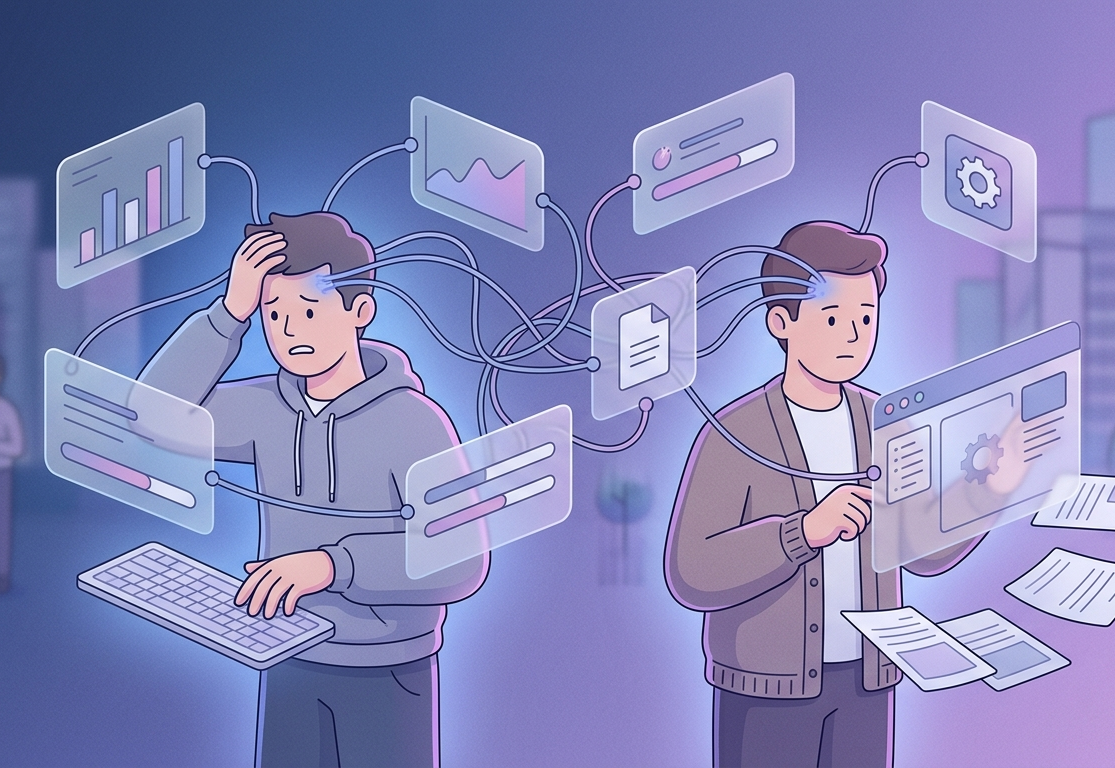
The Hidden Cost of Context Switching at Work
Imagine you're writing an important report. You've finally reached that moment where the ideas start connecting on their own, sentences almost writing themselves, your mind building instead of searching. Then your phone buzzes. A teammate has a quick question, so you answer it. Thirty seconds later, an email notification appears. You glance at it. Another message lands on Slack. Someone tags you in a task.
By the time you return to the report, nothing feels familiar. You reread the last paragraph, then the one before it, trying to remember where you were going. The momentum is gone. It feels like you lost a minute or two. In reality, you likely lost much more.
Modern work has convinced us that productivity means doing many things at once. We celebrate responsiveness, praise people who answer instantly, and fill calendars with meetings that break every working day into dozens of fragments. But most knowledge work isn't slowed down by difficult tasks, it's slowed down by constantly leaving them.
Your Brain Never Truly Multitasks
One of the biggest misconceptions about productivity is the belief that humans can multitask. In reality, the brain rarely runs two demanding cognitive tasks at once, it rapidly switches between them: reading an email, returning to a presentation, answering a chat, checking a notification, going back to the presentation again. Every switch forces the brain to unload one mental model and reconstruct another.
Psychologists call this a "switch cost." Even when an interruption lasts only a few seconds, your brain keeps carrying traces of the previous task while trying to resume the next one, part of your attention stays stuck in what you just left. The interruption isn't expensive because it steals thirty seconds. It's expensive because it steals your mental momentum, and the more complex the work, the greater that cost becomes.
Designing software, writing reports, solving technical problems, planning projects, or making strategic decisions all depend on holding several connected ideas in working memory at once. Every interruption collapses that structure, and you have to build it again from scratch.
The Invisible Tax on Every Workday
Context switching is easy to miss because its cost is scattered throughout the day rather than concentrated in one obvious place. Five interruptions here, three meetings there, a dozen notifications, each one seems harmless on its own. Together, they quietly consume hours of productive thinking.
It's a bit like reading a novel where someone closes the book every three pages to ask you an unrelated question. You'd still finish the novel, but it would take longer, demand more effort, and the story would feel harder to follow. Knowledge work operates the same way: every interruption resets part of your cognitive process, so instead of making continuous progress, your attention spends the day rebuilding context that already existed.
This is one reason many professionals feel exhausted despite accomplishing surprisingly little. Their brains worked all day, they just spent much of that effort recovering from interruptions rather than creating value.
Why Teams Accidentally Make It Worse
Ironically, most interruptions aren't malicious, they're signs of healthy communication. Someone needs clarification. A manager requests an update. A designer has a question. A developer hits a blocker. Individually, every message seems reasonable. Collectively, they create an environment where nobody can think uninterrupted for very long.
As teams grow, communication channels multiply: email, chat, project management tools, meetings, phone calls, comments, notifications. Without anyone deciding it should happen, organizations start optimizing for immediate responses instead of uninterrupted thinking. Responsiveness begins replacing effectiveness, and people start measuring productivity by how quickly they answer messages instead of how much meaningful work they complete. The workplace becomes incredibly active, yet surprisingly little progress happens beneath all that activity.
Deep Work Doesn't Happen by Accident
The opposite of context switching isn't silence, it's intentional focus. High-performing teams don't eliminate communication, they organize it. Questions get grouped instead of sent one at a time. Status updates happen at predictable moments. Work is planned clearly enough that people need fewer interruptions to begin with, and everyone understands priorities before execution starts.
This creates something genuinely valuable: uninterrupted stretches of concentration long enough to hold complex ideas in mind and actually solve difficult problems, instead of repeatedly reconstructing them. The goal isn't isolation, it's protecting the moments when thinking creates the most value.
Better Systems Prevent More Interruptions
Most productivity advice focuses on individual habits, turn off notifications, use a Pomodoro timer, block your calendar. Those techniques help, but many interruptions originate from the system itself rather than the individual. If priorities change daily, people ask more questions. If tasks lack context, teammates constantly seek clarification. If decisions aren't documented, the same conversations happen over and over.
Improving productivity often has less to do with asking people to focus harder and more to do with designing work so fewer interruptions are necessary in the first place. Clear planning reduces uncertainty, shared visibility reduces repetitive questions, and well-defined priorities reduce unnecessary conversations. The system becomes quieter, not because people communicate less, but because they need to communicate less.
The Most Expensive Minutes Are the Ones You Never Notice
Context switching rarely shows up on a timesheet. Nobody logs thirty minutes rebuilding their train of thought or schedules an hour for recovering from interruptions. Yet those invisible moments accumulate every single day. Organizations often search for faster employees, better processes, or new productivity techniques while overlooking a simpler truth: the biggest productivity gains usually come from protecting attention, because attention is where ideas become decisions, decisions become execution, and execution ultimately becomes results.
The next time work feels unusually busy, it may be worth asking a different question. Not "How can we work faster?" but "How often are we forcing ourselves to start over?"
Final Thoughts
Every interruption has a hidden cost that extends far beyond the few seconds it occupies. The real expense lies in rebuilding focus, recovering context, and restoring momentum. Teams that recognize this don't simply ask employees to concentrate harder, they build systems that make concentration possible in the first place.
When work is organized with clarity, priorities are visible, and conversations happen in the right place at the right time, people spend less energy switching between tasks and more energy making meaningful progress. That's where productivity stops being about working harder and starts becoming about working smarter.
Build a Workspace That Protects Focus
The best productivity system isn't the one with the most features, it's the one that helps your team spend less time searching, switching, and asking for context. Polaris is built around a simple idea: when work, conversations, and priorities live in one place, teams spend less time rebuilding context and more time moving projects forward.
If you're looking for a simpler way to organize work without constant interruptions, explore Polaris and see how a shared workspace can help your team stay aligned and focused.
→ Try Polaris today.